
✦ Seasonal Design: A Practice
How to align your creative work with Earth’s actual rhythms

OPEN STUDIO | Winter Solstice | Design Your Season
Join me for a 90-minute live seasonal design workshop this Sunday where we'll harvest fall and design winter together. Walk away with your seasonal container for the next three months.
December 21st, 2-3:30pm Pacific
$27 | Free for paid subscribers | Limited to 20 spots
Register here
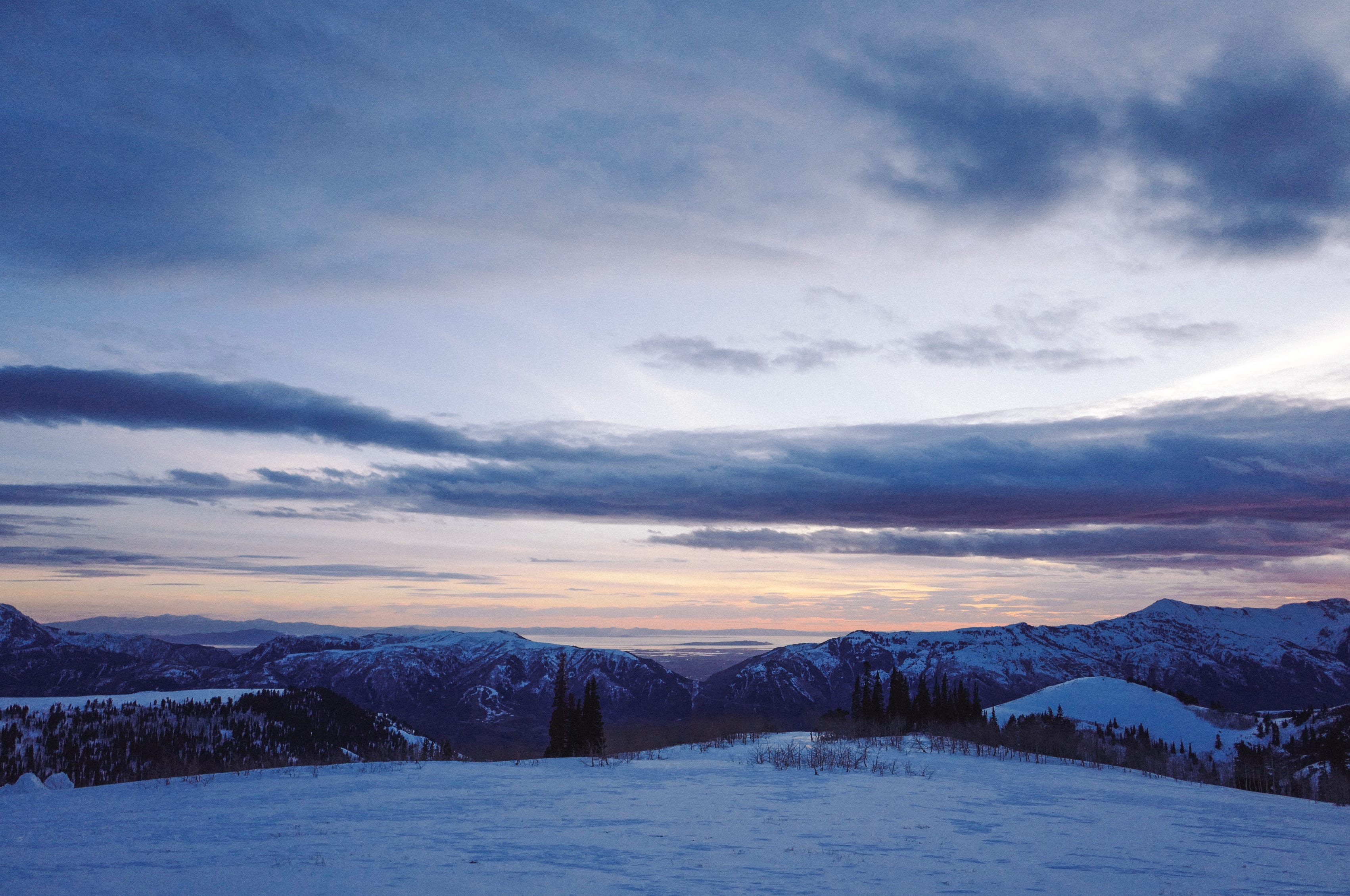
The light is thin now. On the east end of Ojai, the sun dips behind the mountains earlier each day, casting long, blue shadows across the oaks. We’re approaching the winter solstice—the longest night, the pivot point where the year turns back toward the light.
It’s a natural threshold. A time to pause, to look at what’s complete, and to feel into what wants to emerge next.
Many of us orient to this shift through the lens of New Year’s resolutions—that frenzied January impulse to regroup and recommit. But that once-a-year planning cycle has always felt inconsistent to me. We set ambitious targets in the cold of winter, lose momentum by the thaw of March, and arrive at December wondering where the year went.
What if we oriented differently?
What if, instead of forcing our creative work into arbitrary calendar divisions, we let ourselves be guided by something older—Earth’s actual rhythms?
For the past few years, I’ve been experimenting with seasonal design. Not as a spiritual bypassing of practical planning, but as a more congruent way to think about creative containers, energy allocation, and what to prioritize when.
⸻
The creative process is cyclical, not linear
Some of the greatest works of art take years to craft, evolve, come to fruition. But that doesn’t mean the artist worked on the piece every day.
When we look across history and at patterns of great artists, the constant is seasonality. Periods of intensive focus on a particular work. Periods of reset. Or even distraction, diversion.
Author Nancy Stohlman describes it this way:
Periods of furious creation are followed by a slowing down as we recuperate. And those fallow periods are followed by new sparks and new creative discoveries…if we remain patient and trust the process.
The key is trusting the cycle—not fighting it.
Creative work is cyclical in nature. There are periods of intensity and focus, periods where things need to lie fallow. This is the natural way of the creative process. It’s worth designing for.
⸻
Why seasons, not quarters
We all know the feeling of dancing slightly out of sync with the rhythm of the music and how disorienting it can be.
This is what it’s like when your creative rhythm is misaligned with the structure you’re trying to work within. Seasonal design is about tuning your rhythm to celestial bodies and your own internal creative rhythm.
The solstices and equinoxes mark the Earth's relationship to the sun—the longest and shortest days, the moments of perfect balance between light and dark. Cultures across history have gathered at these thresholds to mark transitions, honor cycles, and recalibrate. There's something in us that responds to these turnings. We're not separate from these rhythms—we're made of them.
I wrote recently about rhythm over to-do lists — how designing your time in nested containers (annual → seasonal → weekly → daily) lets you actually access deep work instead of staying scattered. Seasonal design is the macro layer of that architecture.
You can have the perfect daily schedule, but if you’re trying to hold fourteen priorities across multiple seasons simultaneously, you’ll still drown. The seasonal frame gives permission to sequence: this priority this season, that priority next season.
Here’s why this matters for creative entrepreneurs: In corporate environments, there’s built-in structure around goal setting and planning (Q1 > Q2 > Q3 > Q4). As a creative entrepreneur without that infrastructure, you need to architect your own progression. Otherwise you surrender to things happening whenever they happen—scattered, reactive, perpetually distributed.
The biggest unlock of seasonal design: you can relax. You know your focus for the season. You’re not trying to give full attention to everything at once. The anxiety of “all at once” dissolves.
Working with the grain
To be clear: you don’t need to align your creative work with seasonal energetics for this practice to work. Sometimes a film needs to be edited in winter. Sometimes an album needs to be recorded in fall. The practice of pausing at solstices and equinoxes to harvest and design is valuable regardless.
But as my practice has deepened, I’ve gotten more curious about what happens when I do attune to each season’s distinct energy:
Spring is emergence. The time for planting new seeds, research and ideation. Spring asks: What wants to be born?
Summer is full expression. Deep creative immersion. The long days support intensive work—finishing the film, recording the album, writing the manuscript. Summer asks: What’s ready to bloom?
Fall is harvest. Bringing work into the world, launching, sharing, closing loops. Fall asks: What’s ready to ship?
Winter is rest and vision. The fallow time. Tending the inner well, reflection, dreaming what’s next without forcing it into form yet. Winter asks: What needs to compost?
Here’s what I’ve discovered as a multi-hyphenate: Having multiple projects alive but in different stages is actually energizing. One project gets full focus this season while another hibernates in the background—still humming, still somehow working on itself. I’ll have unexpected insights during a film project’s “off season” that completely transform my approach when I return to it. The documentary I’m not actively editing. The song that’s resting. The essay that needs to sit.
Seasonal design doesn’t mean abandoning projects. It means giving each one the concentrated attention it deserves when its season arrives, while trusting the others to compost and evolve in the dark.
⸻
The practice
Over the last few years, I’ve done different versions of this seasonal reflection and planning—journaling, setting OKRs with my studio partner Ian, quiet walks to process what wants to close and what wants to open.
But about a year and a half ago, I started creating something more formal: an orienting document for each season. A kind of handbook to support living into the potential of that three-month window.
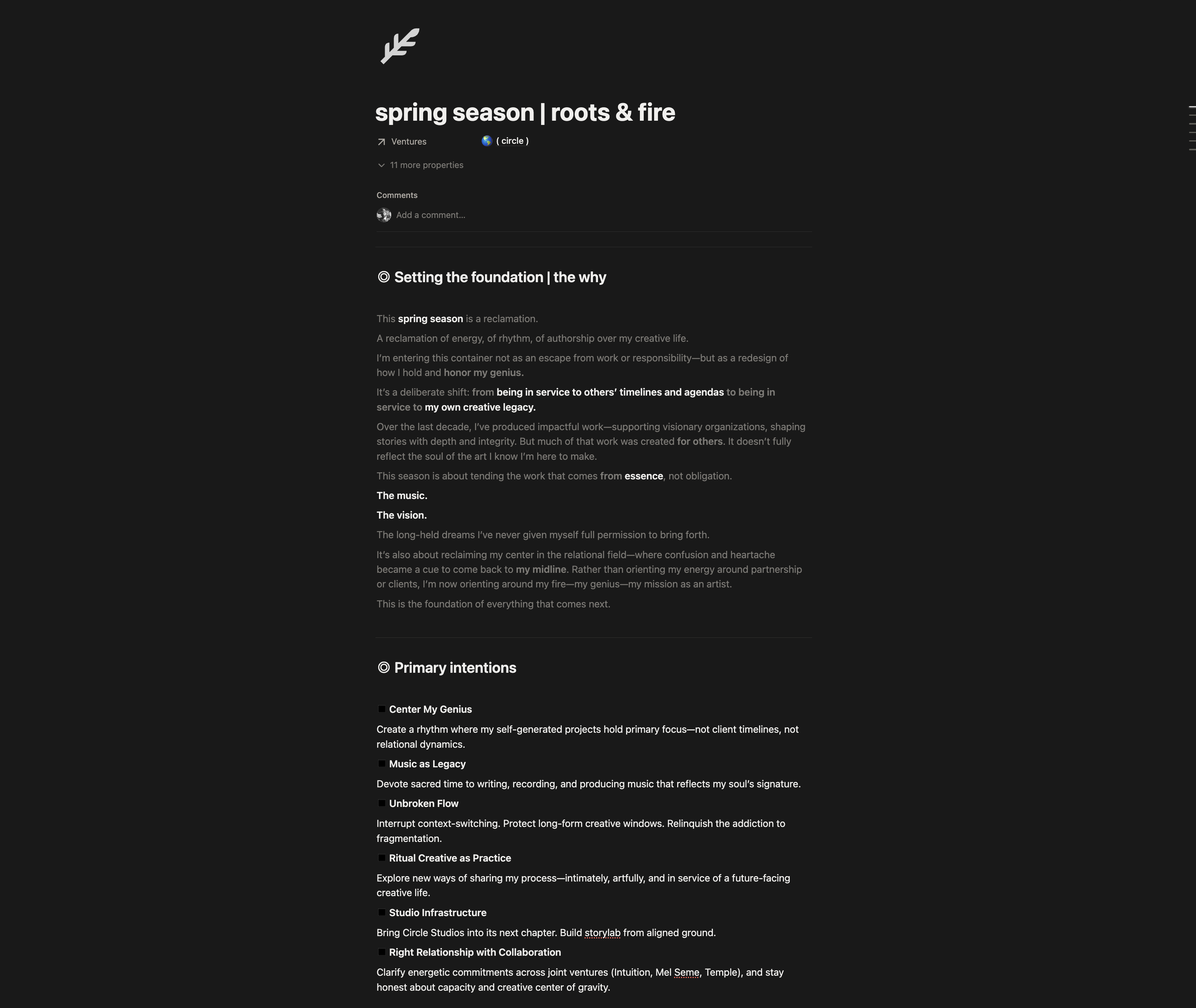
I give each season a name. Not as branding, but as a north star. A phrase I can return to when decisions get muddy.
My last few seasons:
Spring 2025: “roots & fire”
Summer 2025: “embodied emergence”
Fall 2025: “the loving field”
Here’s what matters: these documents aren’t just project planning. They’re tracking my own development and growth. Where are my current edges? What’s challenging me? What support do I need? What’s ready to be transformed?
The creative work I choose to focus on each season is actually the container for deeper personal development. The film project or the album isn’t the point—it’s the vehicle. What I’m really designing for is: How do I create a supportive environment for my own becoming inside the structure of the creative work I’m doing?
That’s what makes this different from a typical goal-setting framework. The projects serve the becoming, not the other way around.
Each season doc includes: the thematic essence, focus areas, protected rhythms, what success looks like, edges I’m working with, support structures I’m building, and truths to keep close.
I take 90 minutes—sometimes walking in the hills around Ojai, sometimes sitting with tea—and record a voice note. I think out loud about everything in my creative field:
What just completed? What wants to close? What’s asking for attention? What felt aligned? What drained me? What do I want more of? What wants to emerge? Where’s the edge of my growth currently? What’s dying for my attention?
It’s messy. Circular. Full of tangents and false starts. That’s the point. I’m not trying to produce a clean document—I’m letting my intuition speak without the rational mind editing in real time.
Then I use AI to help synthesize the voice note into a structured seasonal design doc. Not to write it for me, but to organize the thinking: themes, priorities, what wants to close, what wants to open, the rhythm I’m committing to.
Then I refine it in my own voice. Make it real. Put it in my calendar. Share it with my partner and collaborators so they know what I’m holding.
That’s the practice. Voice note → AI synthesis → refinement.
Simple. Repeatable. Grounded in what’s actually alive rather than what I think should be alive.
Of course, you don’t need to use AI at all in your process. A lined notebook and a pen will do.
Whatever supports you in making the time & building your own map.
⸻
What this isn’t
This isn’t productivity optimization.
I’m not trying to get more done. I’m trying to do less, more deeply. To protect what matters from the tyranny of everything else.
This practice doesn’t give you momentum. It gives you alignment—the feeling of working on things that match where your creative energy actually wants to move. And when you have that alignment, momentum follows naturally.
⸻
Winter Solstice Open Studio
On December 21st, I’m hosting a 90-minute live workshop where we’ll go through this entire process together.
This is a two-part process: harvesting what’s complete, then designing what wants to emerge.
We’ll harvest fall as a group—what’s complete, what wants to close, what you’re celebrating, what you’re releasing.
Then we’ll design winter together. Each person will craft their own seasonal document: focus areas for the season, the protected rhythm(s), practices that support the work, what you’re saying no to.
I’ll share the exact AI prompt I use for synthesis (you can use it for every season going forward). And I’ll offer real-time feedback as you shape your season.
What you’ll leave with:
Your winter seasonal design document (Dec 21 - Mar 20)
The AI prompt and template for future seasons
A peer group of people holding their creative containers with you
Who this is for:
Multi-hyphenate creatives juggling multiple domains
Anyone who feels scattered across too many priorities
People in transition (leaving jobs, launching platforms, reclaiming creative sovereignty)
Anyone who wants to try working with Earth’s rhythms instead of against them
Details:
December 21st, 2 - 3:30pm Pacific (via Zoom)
$27 pilot pricing for this first run
Free for $15/month or annual paid subscribers (along with access to all other workshops and my practice / resource library)
Limited to 25 people
⸻
Can’t make the live workshop? Paid subscribers get the recording + template + AI prompt after the event.
⸻
The deeper invitation
At the solstice, the Earth itself is turning. The light is returning. Things are shifting underground even when nothing looks like it’s moving on the surface.
This is the time to ask: What wants to turn in me? What’s ready to shift? What rhythm wants to guide the next three months?
You don’t need to have it all figured out. You don’t need a perfect plan. You just need to listen to what’s actually alive and create a container to hold it.
The earth knows how to turn toward light.
So do do we.
In rhythm,
Benjamin
Beautiful! I've been thinking on similar themes: https://schoolofwiseinnovation.substack.com/p/invitation-to-regenerative-time
Ben! This post is beautiful, and "Seasonal Design" is something I'd love to experiment with and perhaps, put into practice. It feels so organic, ancient, rhythmic, and basic. I'm crushed that I am unable to join your Sunday workshop. Perhaps we can do a private session? (readers - I am Ben's mom) I'm interested in knowing more about the time of year I was born (October 6), and how or if this has any bearing on my own seasonal design and body's "natural" daily routine. For example, I have always been a "night owl" and NOT a naturally early riser. Just curious, and how this affects my work schedule.